
Individual results may vary. Rx Only. View important safety information at inspiresleep.com/safety.
Best sleep positions for obstructive sleep apnea
Discover how sleep position affects obstructive sleep apnea, ways to improve breathing at night, and treatment options like CPAP and Inspire therapy.
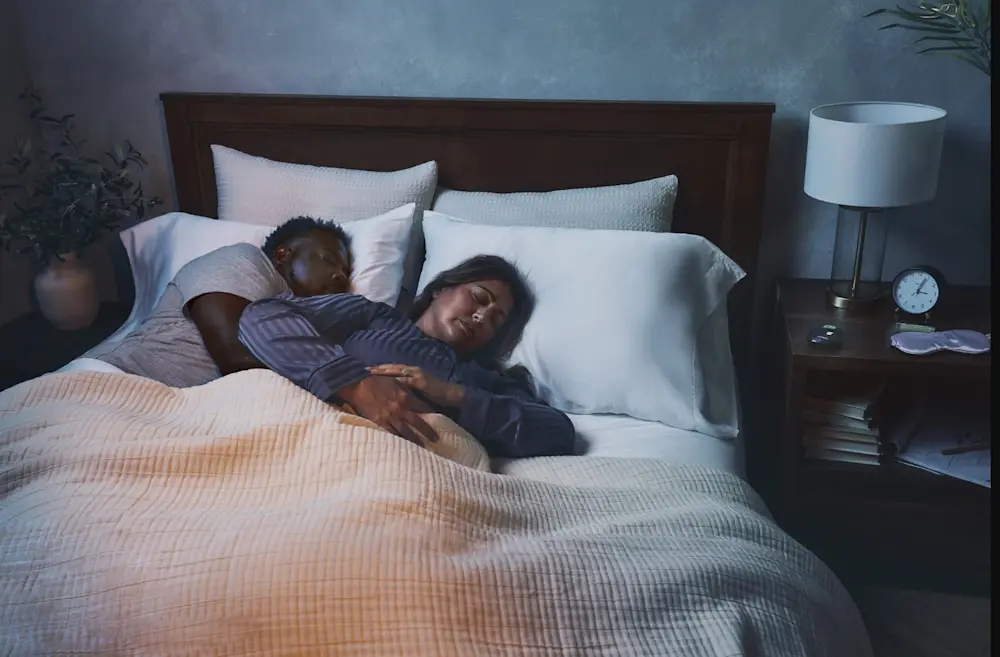
For many people, the position they sleep in is a matter of preference. But for people with obstructive sleep apnea (OSA), the position they sleep in can help relieve symptoms, so they get more quality rest.
Gravity plays a major role in this.
How sleeping on your back worsens sleep apnea symptoms
If you have obstructive sleep apnea, your tongue and other throat muscles and tissues relax in a way that makes them fall back into your airway while you sleep, making it harder to breathe.
Sleeping on your back gives gravity the upper hand, and allows these tissues a “free fall,” increasing the likelihood of your airway getting block. A blocked airway makes breathing difficult. When you can’t breathe, your oxygen levels drop and your brain sends an SOS signal to wake you up. You wake up and take a breath, whether or not you remember it.
When you have moderate to severe obstructive sleep apnea, this cycle can repeat hundreds of times throughout the night, leaving you groggy in the morning and exhausted during the day. Research has shown sleeping on your back may as much as double the number of sleep apnea events you experience.1,2 Over time, this sleep deprivation can lead to accidents and injuries, as well as serious health risks, including high blood pressure, heart disease and obesity.
The link between snoring and sleep position
Back sleeping can also increase snoring, which can disrupt your sleep and that of anyone nearby. Snoring happens when air moves past the soft tissues in the back of your throat, causing them to vibrate and create the rattling sound. Gravity encourages these tissues to fall backward, narrowing the airway and increasing the vibration – and noise.
Getting enough quality sleep is essential to your – and your housemates’ – health and overall quality of life.
Best position for sleep apnea
Why is side sleeping recommended
For people with obstructive sleep apnea, sleeping on your side is typically the best position, because it helps resist gravity’s pull, reducing airway blockages. (While sleeping on your stomach also fights gravity, it can put more strain on your neck and lower back.)
Most people – an estimated 60 percent of adults – sleep on their side, while back sleeping is the second most popular.3 If you’re one of the back sleepers, you can train yourself to favor the side.
Proper spinal alignment
When you sleep on your side, the goal is typically to keep your spine aligned from head to feet. When your spine is properly aligned, it helps prevent strain on your neck, back, hips and knees – all of which can make it more difficult to sleep if left unchecked.
To achieve this, your pillow should cradle your head in a way that keeps your neck neutral. Your knees should be slightly bent – not full fetal – to prevent your lower back from curving. Putting a thin pillow between your knees can help, too.
It's also a good idea to flip over once in a while to avoid favoring – and potentially straining – one side.
Tips for staying on your side
If you are a back sleeper, getting into the habit of sleeping on your side isn’t usually as easy as turning over. Many people will start on their side and flip onto their backs, whether consciously or mid-slumber.
Positional therapy techniques
A few strategies can help you stay on your side:
Use an electronic device that tracks your movement during sleep and vibrates to alert you if you roll onto your back.
Prop yourself up against pillows so you don’t roll onto your back.
Sew a pocket onto the back of your pajama top and put a tennis ball or something similar in it. If you roll onto your back, the object makes you uncomfortable and signals you to roll to your side again.
These “positional therapy” techniques can help some people reduce their sleep apnea symptoms enough to get quality sleep. But many people, especially those with moderate to severe obstructive sleep apnea, need additional treatment to manage their symptoms and bring them to a safe level.
CPAP therapy and sleep position
How CPAP works
Many people with moderate-to-severe obstructive sleep apnea are prescribed a continuous positive airway pressure system (CPAP). The system delivers pressurized air through a mask to keep your airway open while you sleep.
Choosing the right mask
Masks come in different styles – including nasal pillows, nasal masks or full-face masks – which can be more or less comfortable depending on your sleeping position. However, sleeping on your stomach can be challenging with CPAP – the mask can press against your face or shift into the wrong position.
Common challenges with CPAP
Despite its effectiveness at reducing sleep apnea symptoms, about half of patients struggle or stop using their CPAP therapy.4,5 This is often because they find wearing a mask uncomfortable, the machine noise disturbing or have trouble keeping up with the daily maintenance.
Implantable therapy – a mask-free option
Many of the patients who can’t tolerate CPAP become interested in Inspire® therapy. It’s one of the most chosen next-line options and offers the freedom to sleep the way you want. Inspire therapy is highly rated by patients – and 91% of Inspire patients say Inspire therapy is better than CPAP.6
How Inspire therapy works
Inspire therapy is a mask-free7 solution that works comfortably8 inside your body to treat the root cause of obstructive sleep apnea. The small Inspire® implant gently stimulates the hypoglossal nerve – which controls tongue movement – to help gently move your tongue forward to keep your airway open, so you can breathe regularly and sleep soundly.
Insurance coverage and safety
Both Inspire therapy and CPAP are proven to be safe and effective treatment options for obstructive sleep apnea. They both work well for many individuals. And they both offer strong insurance coverage options by commercial plans, Medicare and Veterans Affairs (VA).
Making yourself more comfortable
Another common tip for people with sleep apnea is to practice good sleep hygiene to create an environment that encourages sleep. This includes choosing a mattress and bedding that helps you relax and snuggle in.
Choosing your mattress and pillows
Whether you prefer a firmer or softer mattress and pillows is up to you, as long as they provide the support you need to keep your spine aligned and to feel comfortable. If you have a bed partner, it may help to have side-by-side adjustable mattresses or two twin beds pushed together. That way, you can each sleep as you wish without compromising the other person’s comfort.
Ideal room conditions
It’s also best to keep your room dark and cool, avoid bright display lights and screens, and, if it’s helpful, add white noise – such as a soft fan – to help tune out distractions.
Allergy control
If you have allergies that affect your nasal passages, it’s especially important to regularly wash your bedding. This helps reduce the natural build-up of dander and dust that worsen symptoms.
Key takeaway
To improve obstructive sleep apnea, focus on your sleep position, treatment and environment – so you can breathe more easily and wake up ready for the day.
Consult a doctor
If you’re struggling to get comfortable enough to sleep, talk to your doctor. They can offer suggestions and also help determine if something else may be going on.
Sources
1 ScienceDirect, A review of supine position related obstructive sleep apnea: Classification, epidemiology, pathogenesis and treatment. September 16, 2023.
2 Sleep Foundation, Best Sleeping Position for Sleep Apnea. July 29, 2025.
3 Sleep Foundation, What Is the Best Sleeping Position? July 25, 2025.
4 Rotenberg et al. Trends in CPAP adherence over twenty years of data collection: a flattened curve. Journal of Otolaryngology Head and Neck Surgery 2016; 45:43
5 Weaver, TE, Sawyer, AM. "Adherence to Continuous Positive Airway Pressure Treatment for Obstructive Sleep Apnea: Implications for Future Inventions." Indian Journal of Medical Research, 2010; 131: 245-258.
6 Data on file.
7ADHERE Registry: Data on File.
8 Suurna MV, Steffen A, Boon M, et al. Impact of Body Mass Index and Discomfort on Upper Airway Stimulation: ADHERE Registry 2020 Update. Laryngoscope 2021; 131(11): 2616-2624
American Heart Association, Can sleep position affect your heart and brain health? January 24, 2025.
Johns Hopkins Medicine, Choosing the Best Sleep Position. Accessed August 21, 2025.
Sleep Foundation, How to Choose a CPAP Mask Based On Your Sleep Position. July 9, 2025.
Sleep Medicine Research, Positional Therapy for Obstructive Sleep Apnea: Therapeutic Modalities and Clinical Effects. September 30, 2023.