Individual results may vary. Rx Only. View important safety information at inspiresleep.com/safety.
From sleep divorce to shared nights: How one couple overcame snoring and obstructive sleep apnea
Becky and Bill S. overcame snoring and obstructive sleep apnea to stop sleeping separately and improve their relationship.

Snoring and obstructive sleep apnea (OSA) may not just affect sleep — they may create serious relationship problems.
For some couples, this leads to ‘sleep divorce.’ Sleep divorce is when couples choose to sleep in separate beds or rooms due to disrupted sleep.
Sleep disorders — such as obstructive sleep apnea (OSA) — are commonly associated with sleep divorce. This is due to loud snoring, tossing and turning and even the use of external devices.
Untreated sleep apnea may also increase the risk for serious conditions like stroke, heart attack, type 2 diabetes and dementia/Alzheimer’s.
So, worrying about your partner’s health may also cause some restless nights — especially if you need to nudge or wake up your partner if they stop breathing.
A 2025 survey conducted by Inspire Medical Systems, Inc. shows the potential impact of sleep apnea on bed partners.
Nearly 60% of bed partners said they worry about their loved one’s health because of sleep apnea.1
Relationships may also suffer if partners need to move to the couch or another room. 50% of surveyed bed partners say they are not getting enough sleep.1
And 8 in 10 surveyed couples who sleep apart due to sleep apnea symptoms say they wish they could share a bed again.1
A Continuous Positive Airway Pressure (CPAP) machine is the first-line treatment for OSA. But about half of CPAP users cannot use or do not receive benefit from CPAP.
When CPAP fails for you, there are other options for your OSA to discuss with your provider, including Inspire® therapy.
The small Inspire® implant works inside the body to sense breathing and prevent apneas. It delivers gentle pulses to the airway muscles to keep it open without the need for a mask or a hose.
You turn it on with a remote. And it shuts off automatically after a time set by you and your provider.
You can also turn it off or pause therapy manually.
Of respondents whose bed partners have a surgical implant like Inspire therapy, 9 in 10 said they do not sleep poorly.1
How snoring can lead to sleep divorce and relationship problems
Snoring is one reason couples begin sleeping separately. This is commonly known as “secondhand snoring,” where one partner’s snoring disrupts the other person’s sleep and overall health.
What may start as a minor annoyance can gradually turn into a larger issue — especially when sleep becomes consistently disrupted night after night.
One study shows that 86% of separated couples noted snoring as the primary reason.2
For many couples, this leads to what’s known as sleep divorce, meaning they choose to sleep in separate rooms to get better rest.
While this arrangement can offer short-term relief, it can also create emotional distance over time. Over time, this may lead to:
• Increased stress and irritability
• Communication breakdowns
• Reduced quality time together
But what happens when both partners snore and have OSA?
Becky and Bill said, ‘I do,’ about 36 years ago.
But sleeping separately due to OSA symptoms like snoring became a recurring challenge.
First Bill’s symptoms and then Becky’s made it difficult to share a bed, despite their strong relationship.
Like many couples experiencing the sleep divorce trend, they did not want to stay apart — they simply wanted better sleep together.
Their story highlights a common reality: snoring and sleep apnea do not just affect individuals — they can have a real impact on marriage and long-term relationships.
Becky and Bill’s sleep issues
Bill showed signs of OSA first.
Becky said his loud snoring interrupted her sleep. And she woke up to tell him to turn over often.
Bill eventually had to change rooms for Becky’s sake, but neither liked the arrangement.
He decided to get a sleep test and received an OSA diagnosis.
They started him on CPAP, and he adapted well to it.
His symptoms improved, and he and Becky started sleeping in the same bed again.
But then, Becky began to show signs of OSA.
She also woke up tired and needed to drink several cups of coffee to get through the day. She also experienced memory issues and brain fog.
“When I woke up in the morning, I did not feel rested,” she said. “Sometimes it was kind of a chore to get out of bed.”
Becky also needed long, hour-and-a-half naps in the middle of the day.
But the worst part is that she and Bill once again slept in separate rooms.
Her loud snoring affected Bill’s sleep enough to make him nudge her to roll over or move.
It eventually led her to sleep in a guest room or on the couch.
“Sleeping in two separate rooms was disruptive,” Becky said. “You’re getting up in the middle of the night and having to take your pillow and get some blankets or whatever to go and sleep somewhere else. And by that time, you’d already disrupted your sleep and then sometimes, it wasn’t easy to fall back asleep."
“So hence, I would wake up in the morning not feeling very rested.”
And like before, this is not what either wanted.
The two lost their son in 2013 to an accidental overdose, and it was not an easy time.
They survived by supporting each other, and it brought them closer together.
Neither wanted to experience sleep divorce.
“I didn’t like it, and he didn’t like it either,” she said. “I’m married for a reason, and I’m married because I want to share my life with the person that I said, ‘I do’ to 36 years ago.”
Bill pushed Becky to get a sleep test. Sure enough, the results showed she had moderate obstructive sleep apnea.
But unlike Bill, CPAP did not offer the same relief for her.
Becky does not like to sleep with anything around her face. Even with experience adapting to scuba diving masks and regulators, she struggled to keep her CPAP mask on for the full night.
She is also a side and stomach sleeper — making it difficult to sleep with a hose and mask.
Switching to nose clamps did not help, and she gave up on CPAP after a little more than a month.
“I felt like I was almost sleeping worse because I would toss and I would turn and couldn’t get comfortable,” she said. “I know people that adapted to it just fine, but it just did not work for me.”
Becky also tried a mouth guard, but it made her gag.
And her poor sleep lasted a year — including the difficulties of sleeping apart from Bill.
This is when Bill, who is also a provider, first mentioned Inspire therapy, an alternative option he read about.
Little did they know it would change their lives.
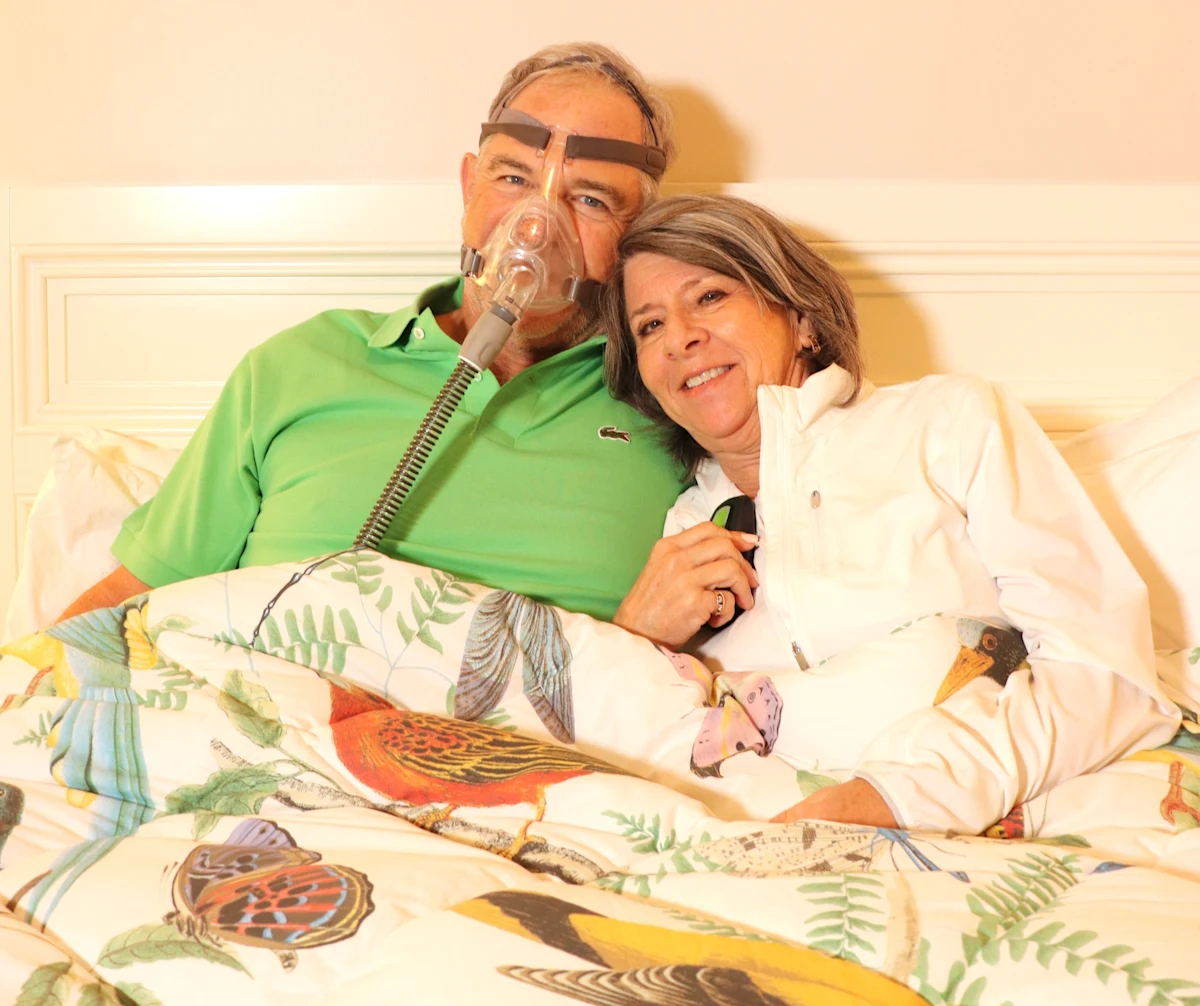
Becky and Bill are both happy with their obstructive sleep apnea treatments. The success they have allows them to share a bed once again.
Sharing a bed again
Becky started the process and eventually qualified for the Inspire implant. She received it in 2021.
Her provider adjusted settings, and after a year, she started feeling the benefits of good sleep.
She has more energy and does not feel as tired as before.
She gets up at 7 a.m. to read the paper before starting her day, and her lifestyle is as busy as ever — either volunteering, going to yoga, going to book club, working out, walking, gardening, spending time with friends or having date nights with Bill.
Both Becky and Bill feel healthier than before treatment, as well, and they travel more than ever — both together and with friends.
“Bill and I both have sleep apnea, but we both treat it in different ways,” Becky said. “His CPAP machine works for him, and the Inspire device works for me. So that’s how our little marriage goes.”
And best of all, they sleep in the same bedroom again. This is because they do not snore as loud anymore.
90% of bed partners who use Inspire therapy report no snoring or soft snoring.3
Becky said that they have friends who also experienced sleep divorce, and it impacted their relationship as well.
“The fact that we can sleep together now and have our little pillow talk and wake up in the morning and look at the person you love, it’s pretty nice,” she said.
How to sleep better with a snoring partner (and when to seek help)
If you are experiencing problems with a partner’s snoring, you are not alone. Many couples struggle to balance sleep quality with staying connected.
Fixing snoring issues in a marriage often starts with identifying potential underlying causes like sleep apnea.
Here are ways to sleep better with a snoring partner before resorting to sleeping separately:
• Encourage your partner to sleep on their side, which may reduce snoring
• Use white noise, earplugs or sound machines to minimize disruption
• Maintain consistent sleep schedules to improve overall sleep quality
• Avoid alcohol close to bedtime, as it can worsen snoring
• Most importantly, consider a sleep evaluation, especially if symptoms suggest obstructive sleep apnea
For couples like Becky and Bill, addressing snoring and sleep apnea did not just improve their sleep — it helped them reconnect and share their lives again.
FAQs about sleep divorce, snoring and relationships
Is it normal to sleep separately because of snoring?
Sleeping separately — often called sleep divorce — is increasingly common.
Research from the American Academy of Sleep Medicine shows that about one-third of U.S. adults have chosen to sleep in another bed or room to accommodate a partner’s sleep issues, including snoring.
While this can improve sleep in the short term, many couples prefer to find solutions that allow them to share a bed again.
Can snoring really cause relationship problems?
Snoring is linked to sleep disruption, stress, and relationship strain. Studies show that up to 75% of people with a snoring partner report disrupted sleep, which can lead to irritability, poor communication, and reduced relationship satisfaction.
Over time, this can create emotional distance — especially if couples begin sleeping apart.
What is “secondhand snoring”?
“Secondhand snoring” refers to the negative effects a person experiences from their partner’s snoring, including lost sleep and fatigue. Research suggests bed partners may lose one to two hours of sleep per night, leading to chronic sleep deprivation over time.
This highlights that snoring is not just an individual issue — it can affect both people in a relationship.
When is snoring a sign of something more serious?
Snoring may indicate obstructive sleep apnea (OSA) when it is paired with symptoms like:
• Gasping or choking during sleep
• Pauses in breathing
• Excessive daytime fatigue
OSA is a serious condition linked to heart disease, stroke and other health risks, and it often affects both the individual and their partner’s sleep quality.
If these symptoms are present, a sleep evaluation is recommended.
Does treating sleep apnea improve relationships?
In many cases, yes. Research shows that treating OSA can significantly improve both sleep quality and relationship satisfaction, with many couples reporting they are able to sleep together again after treatment.4
Additionally, studies indicate that partners benefit directly from treatment, experiencing better sleep and improved well-being.2
Sources
1 These results were not part of a formal clinical trial. The findings are from a survey conducted by BarkleyOKRP on behalf of Inspire Medical Systems, Inc., and sent to a random sample of n=1,000 bed partners of individuals diagnosed with sleep apnea.
2 Cascais Costa C, Afreixo V, Cravo J. (2023) Impact of Obstructive Sleep Apnea Treatment on Marital Relationships: Sleeping Together Again? Cureus. 15(10): e46513
3 Woodson BT, Strohl KP, Soose RJ, et al. Upper Airway Stimulation for Obstructive Sleep Apnea: 5-Year Outcomes. Otolaryngology Head Neck Surgery 2018; 159(1):194-202
4 Luyster FS. (2017) Impact of obstructive sleep apnea and its treatments on partners: a literature review. J Clin Sleep Med. 13(3): 467–477
American Academy of Sleep Medicine, “A 'sleep divorce' is common among couples.” July 21, 2025
Snoresy, “Snoring & Relationships: 45+ Statistics on How Snoring Affects Couples.” March 23, 2026
Snorple, “Second-Hand Snoring: The Hidden Health Toll on Your Bed Partner.” April 2026
Weill Cornell Medicine, “Should You Consider a Sleep Divorce?” March 14, 2024
Sleep Foundation, “When Your Partner Snores, No One Sleeps.” Feb. 15, 2024
Sleep Foundation, “How to Stop Snoring.” June 3, 2026
Science Insights, “Is It Healthy for Couples to Sleep in Separate Rooms?” March 21, 2026
SleepApnea.org, “How to Sleep When Someone Is Snoring.” April 24, 2026
Related Articles
 Patient Stories
Arizona woman finds relief from sleep issues with Inspire® therapy
Joanne Zeoli uses Inspire® therapy to treat her obstructive sleep apnea (OSA) today.
Read More Patient Stories
Traveling around the country with Inspire® therapy
Rex Partlow and his wife are happily retired and traveling around the country today.
Read More Patient Stories
Inspire® therapy helps Indiana school teacher get her ‘pep’ back
Inspire® therapy ended up being the answer to Nancy Magyar’s problems.
Read MoreInterested in learning more?
We’re here to help. Fill out the form below to receive more information about Inspire therapy, including how to qualify and what to expect.